































Bengaluru’s Lakes: A Journey Through History, From Ancient Water Tanks to Today’s Urban Crisis
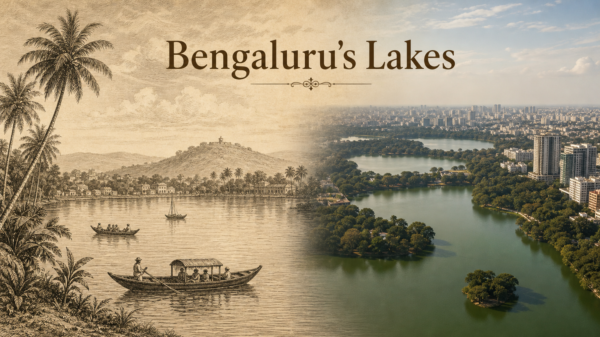
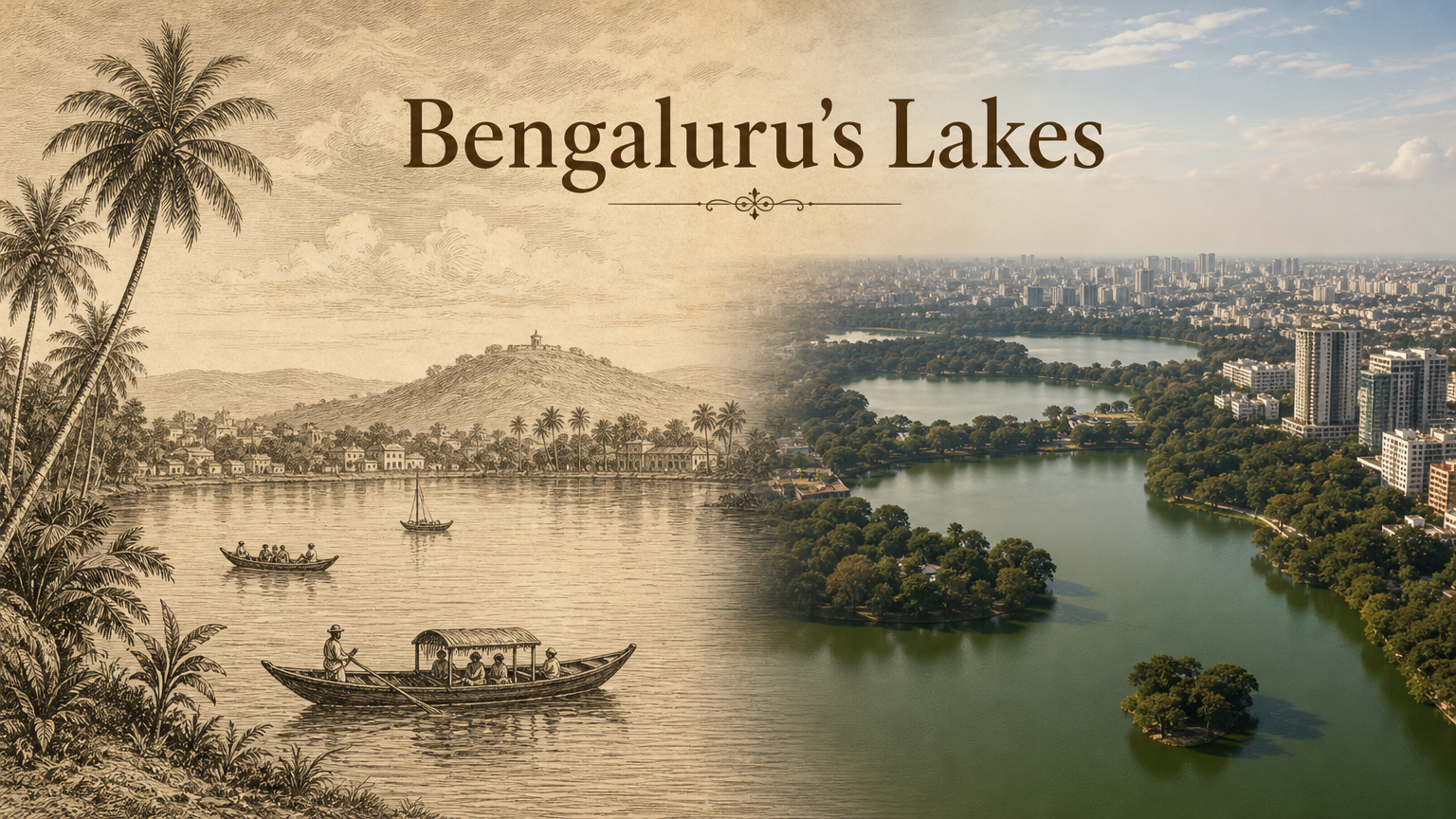
Bengaluru was once called the “City of Lakes.” A British officer travelling through the region in the late 18th century described it as the “Land of a Thousand Lakes.” These were not just pretty water bodies. They were the lifeblood of a city built on a high ridge, far from major rivers.
Long before piped water and borewells, Bengaluru depended on a brilliant network of man-made tanks and interconnected channels. They supplied drinking water, irrigated farms, recharged groundwater, controlled floods, and supported rich biodiversity. Today, that legacy is crumbling under concrete, sewage, and neglect. This is the story of how Bengaluru built its future on water—and why that future is now at risk.
Historical Background: How Bengaluru Became the City of Lakes
The Kempegowda Era
The history of Bengaluru’s lakes begins in earnest in 1537, when Nadaprabhu Kempegowda I, a chieftain under the Vijayanagara Empire, founded modern Bengaluru. Legend says his mother advised him: “Keregalam kattu, marangalam nedu” — build lakes, plant trees. It was practical wisdom. Bengaluru sits at an elevation of about 920 metres (3,020 feet) above sea level. It has no major river of its own, and rainfall was historically scarce.
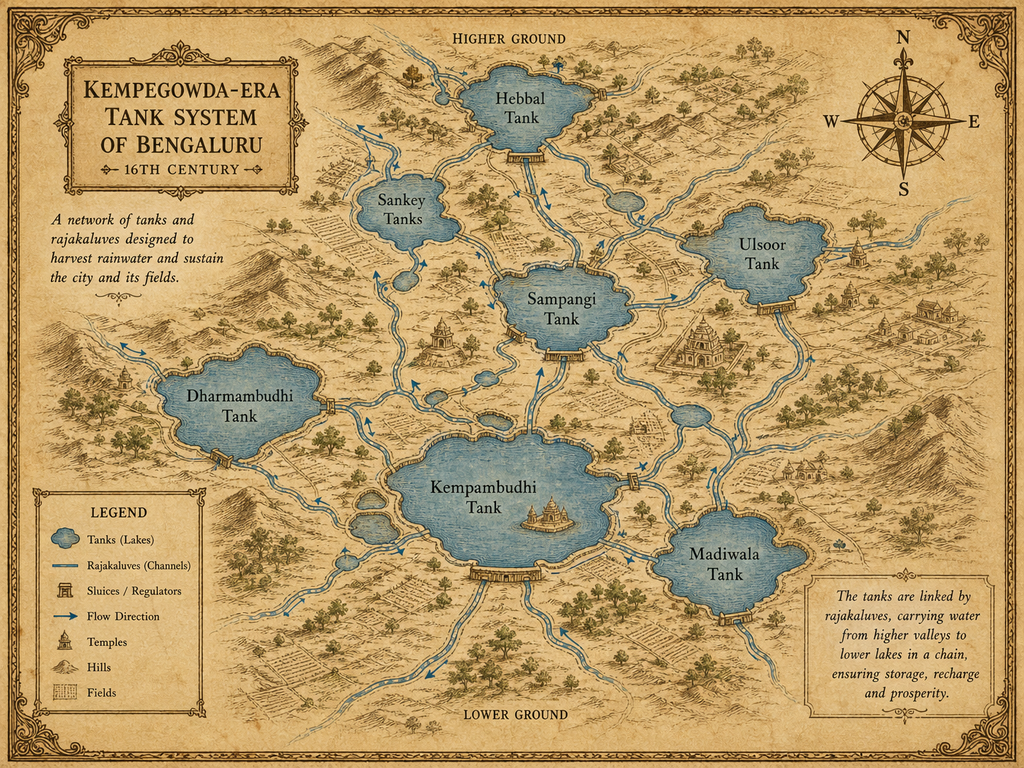
Kempegowda and later rulers constructed a cascade of irrigation tanks across the city’s natural valleys. These tanks were simple but genius: farmers built bunds (low mud walls) across valleys to trap monsoon rainwater. Extra water flowed through channels called rajakaluves to the next lake downhill. No water was wasted.
The Traditional Lake-Chain System
This interconnected lake-chain system turned Bengaluru’s undulating terrain into an advantage. Lakes at higher elevations fed lakes at lower elevations through a network of streams and stormwater drains. The lowest lakes emptied into larger valleys. Communities managed this system through the neeruganti families—traditional waterkeepers who operated sluice gates, maintained canals, and advised farmers on crops.
Silt removed from lake beds was used as fertiliser. Grasslands around lakes fed cattle. Fish thrived. It was a self-sustaining cycle that lasted for centuries.
Mysore Kingdom and British Period
Lakes were maintained by local communities, philanthropists, and rulers. During the Mysore Kingdom, tanks were expanded and protected. When the British established their cantonment in Bengaluru in the early 19th century, they too recognised the value of these water bodies.
A survey conducted in 1830 recorded close to 20,000 water bodies in the broader Mysuru region. In the 1890s, the British introduced piped water from the Arkavathi River to supplement the tank system. Colonel Richard Sankey built Sankey Tank in 1882 to serve the growing population. But even as modern water supply arrived, the old tank system remained vital—until it did not.
Famous Historical Lakes of Bengaluru
Ulsoor Lake
One of the largest and oldest surviving lakes, Ulsoor Lake dates back centuries. A British sketch from 1834 shows it as a centre of agriculture and local activity. Located in central Bengaluru, it was originally built for irrigation and water storage. Today, it is managed by the military and the civic body, and while it remains a popular spot, it faces pollution and siltation challenges.
Sankey Tank
Built in 1882 by British engineer Richard Sankey, this tank was designed to meet the drinking water needs of the growing city. It was historically linked to the Dharmambudhi Tank and Hebbal Lake through streams. Located in the Malleshwaram-West Punjagutta area, Sankey Tank is now a well-maintained recreational space, though its original role in the city’s water network is largely forgotten.
Madiwala Lake
Located near BTM Layout in south Bengaluru, Madiwala Lake is believed to have been built as early as the 12th century during the Chola period, making it one of the oldest water bodies in the region. It originally served agricultural communities. Today, it is surrounded by dense urban development and struggles with sewage inflow, though some rejuvenation efforts have been attempted.
Hebbal Lake
Situated in north Bengaluru, Hebbal Lake was part of the historic chain of tanks feeding the city’s northern valleys. It was historically important for irrigation and is now recognised as a significant bird habitat. However, like many urban lakes, it battles encroachment and pollution from nearby development.
Bellandur Lake
The largest lake in Bengaluru, Bellandur was once a healthy water body in the south-eastern part of the city. It was part of the natural valley system and supported farming and fishing. Today, it is infamous for toxic froth, fires, and severe pollution from untreated sewage and industrial waste. It has become a symbol of the city’s environmental failure.
Varthur Lake
Downstream from Bellandur, Varthur Lake receives whatever flows out of its larger neighbour. Located near Whitefield, it was historically an agricultural tank. In recent years, it has made headlines for massive foam spills onto roads and for extreme pollution levels that threaten nearby communities and aquatic life.
Agara Lake
Located near HSR Layout, Agara Lake is an ancient tank that once supported local villages. After years of neglect, it saw partial restoration with walking paths and better fencing. It remains an important ecological island in one of Bengaluru’s busiest tech corridors.
Lalbagh Lake
Inside the iconic Lalbagh Botanical Garden, this lake is an integral part of Bengaluru’s heritage. Established during the reign of Hyder Ali and later expanded by Tipu Sultan in the 18th century, the lake was designed as part of a grand garden complex. It still exists today but requires constant care to handle park visitor pressure and water quality issues.
Yediyur Lake
Located in the Jayanagar area of south Bengaluru, Yediyur Lake is an old neighbourhood tank that has survived urbanisation. It has been the focus of local citizen efforts to prevent encroachment and maintain water quality, though it remains under pressure from surrounding development.
Kempambudhi Lake
One of the earliest tanks attributed to Kempegowda himself, Kempambudhi Lake in Gavipura (near Chamrajpet) is steeped in history. It was once a reliable water source for the old city. Today, it is heavily polluted and encroached upon, with much of its original area lost to urban growth.
Dharmambudhi Lake
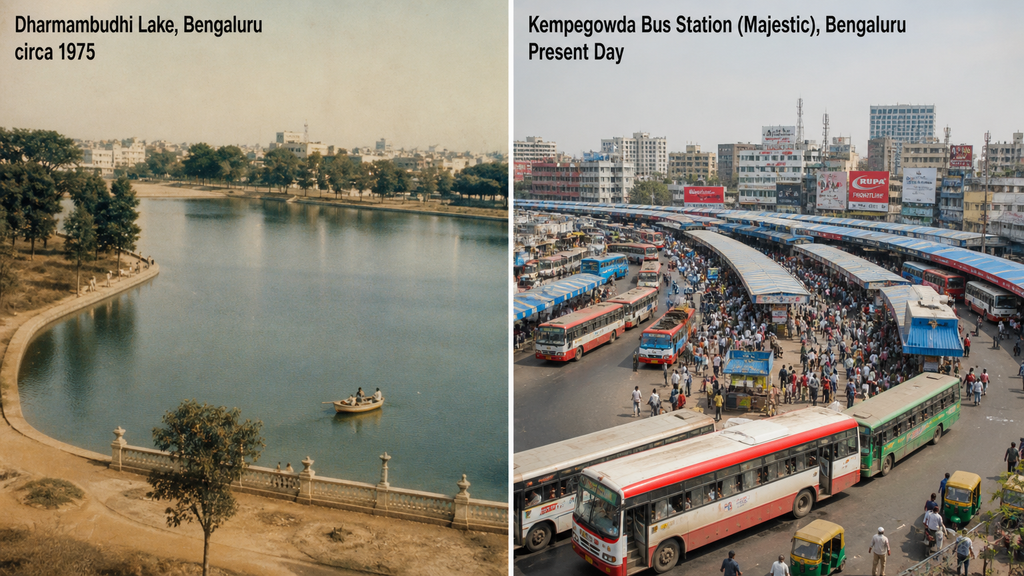
Perhaps the most famous “lost” lake, Dharmambudhi Tank was a crucial water source when Kempegowda founded Bengaluru. It was connected to Sankey Tank and Hebbal Lake through streams. In 1963, the government handed over 1,36,294 square yards of the tank bed to KSRTC. By 1969, it had become the Kempegowda Bus Station (Majestic), Bengaluru’s central transport hub. The lake exists only in old photographs and memory.
Sampangi Lake
The Sampangi Tank once occupied the area where the Kanteerava Stadium stands today, near Cubbon Park. It was a cultural and recreational water body in the heart of the city. The stadium, founded in 1946, and the surrounding built environment permanently erased this historic tank from the landscape.
Nagavara Lake
Located in north Bengaluru, Nagavara Lake is now overshadowed by Manyata Tech Park, parts of which were built on the lake’s former floodplains and stormwater drains. While the lake itself partially survives, its catchment area has been severely compromised by commercial development.
Jakkur Lake
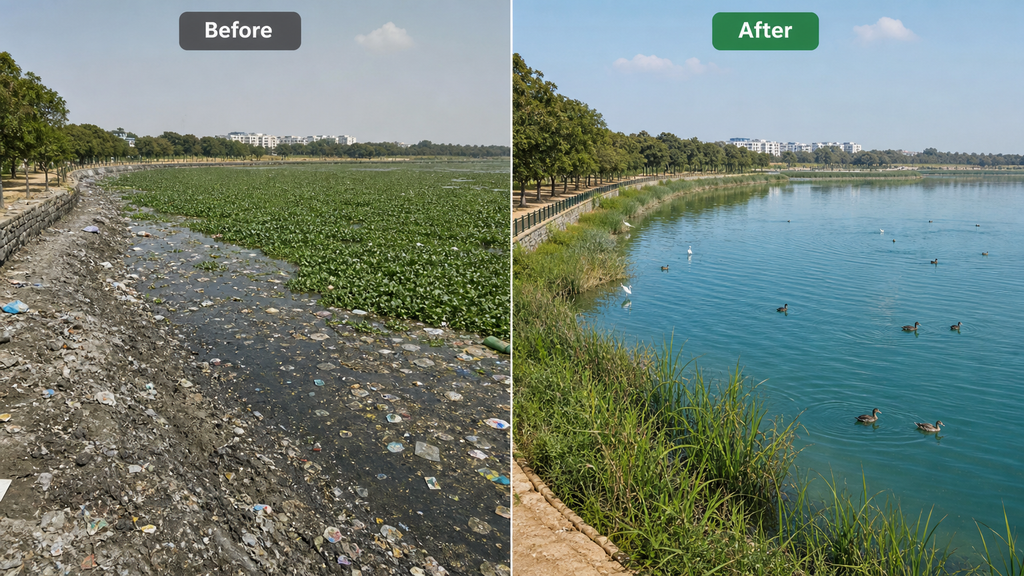
Jakkur Lake in north Bengaluru is a rare success story. Once heavily degraded, it was rejuvenated through a combination of government funding and active citizen participation. It now features a sewage treatment plant, a healthy wetland ecosystem, and is a popular birdwatching spot. It proves that restoration is possible.
Kaikondrahalli Lake
Located near Sarjapur Road, Kaikondrahalli Lake was nearly dead by the early 2000s. Persistent efforts by local resident groups, working with the BBMP, transformed it into a thriving ecosystem with clean water, walking tracks, and returning birdlife. It is now a model for community-driven lake restoration.
Other Notable Lakes
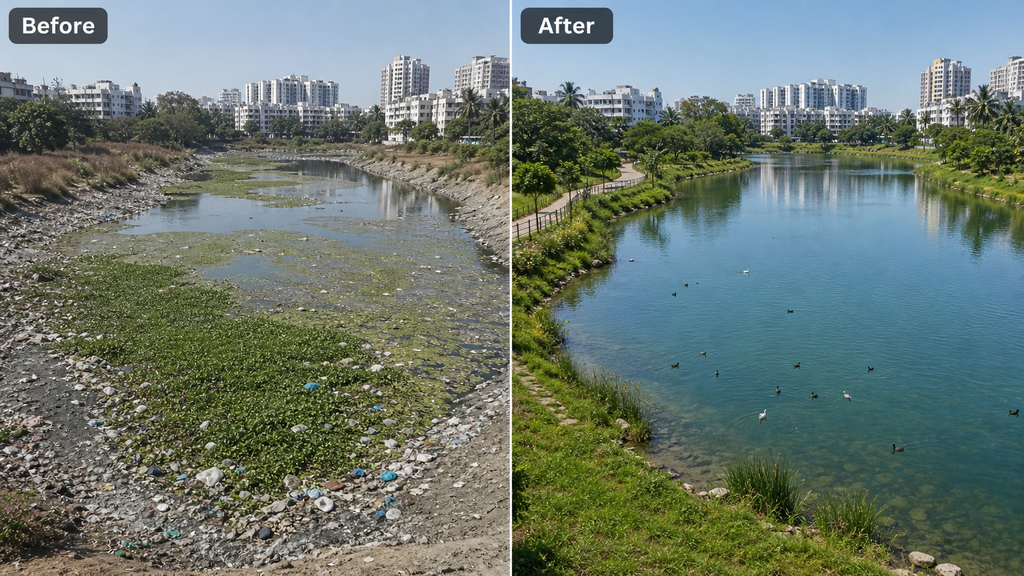
- Puttenahalli Lake (JP Nagar): Another citizen-led restoration success.
- Hesaraghatta Lake: Built by the British in 1894 for water supply, now often dry.
- Thippagondanahalli (TG Halli) Reservoir: Built across the Arkavathi in the 1930s, once a major water source, now decommissioned for drinking water due to pollution.
- Siddikatte Lake: Now the site of Bengaluru’s Krishnarajendra (City) Market.
How Bengaluru Lost Its Lakes
Rapid Urbanisation and Population Growth
After Independence, Bengaluru transformed from a pensioner’s paradise into India’s Silicon Valley. As farming declined and the IT boom began in the 1990s, land prices skyrocketed. Lakes became real estate.
Encroachment and Illegal Construction
Neighbourhoods like Domlur, Koramangala, and JP Nagar were built over former lake beds. Private developers and government agencies alike encroached on lake land. By the 2000s, nearly 235 acres of lake land had been encroached upon by both private and public entities.
Conversion to Infrastructure
Lakes were filled to build bus stands, stadiums, markets, and roads. The Dharmambudhi Tank became Majestic Bus Stand. The Sampangi Tank became Kanteerava Stadium. The Siddikatte Lake became City Market. Kalasipalya stands on a former lake bed. These were not random losses—they were policy choices.
Sewage and Industrial Waste
Millions of homes, especially in peripheral areas built during the IT boom, had no sewage connections. Wastewater flowed untreated into the nearest lake. Industries added chemical waste. Lakes became toxic swamps.
Government Planning Failures
In 1962, the Karnataka government enacted a uniform irrigation policy and took over lakes as government property. The traditional neeruganti system was dismantled. Centuries of indigenous water management knowledge were discarded in favour of bureaucratic control that lacked local understanding or adequate budgets.
Weak Enforcement
Despite laws protecting water bodies, enforcement was weak. Multiple agencies—BBMP, BDA, KSPCB, and others—worked in silos. No single body had full authority or accountability.
Bengaluru’s Lake Pollution Crisis
The pollution crisis is not abstract. It is visible, toxic, and dangerous.
Bellandur Lake’s Froth and Fire
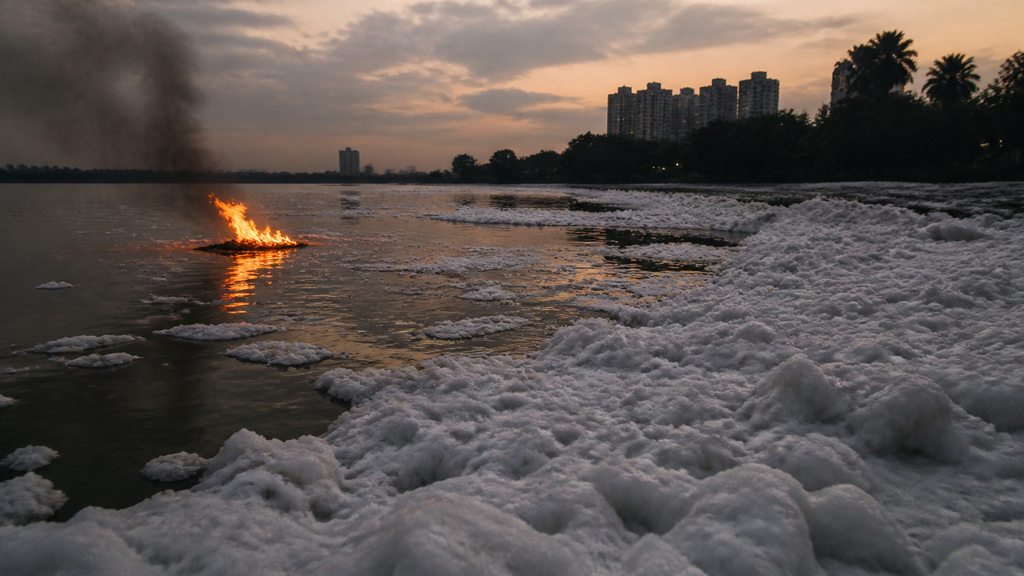
Bellandur Lake has repeatedly caught fire due to high levels of methane and chemicals in the water. Toxic white froth spills onto adjacent roads during monsoons, creating hazardous driving conditions. The lake receives hundreds of millions of litres of untreated sewage daily.
Varthur Lake Pollution
Varthur Lake’s foam has reached several feet in height, flowing over bridges and into streets. The water is heavily contaminated with nitrates, phosphates, and heavy metals.
Untreated Sewage and Chemicals
According to recent assessments, a majority of Bengaluru’s surviving lakes receive untreated or partially treated sewage. Plastic waste, construction debris, and industrial effluents add to the problem.
Impact on Life and Health
Fish kills are common. Bird populations have declined. Communities living near polluted lakes report health issues, foul odours, and declining property values. The lakes, once assets, have become health hazards.
Government and Court Interventions
BBMP and BDA
The Bruhat Bengaluru Mahanagara Palike (BBMP) became the official custodian of city lakes in 2007. The Bangalore Development Authority (BDA) controls some lake land for development projects. However, coordination between agencies remains poor.
KSPCB
The Karnataka State Pollution Control Board (KSPCB) monitors water quality. In recent years, its reports have classified many lakes under poor quality categories, pushing for action against polluting industries and apartment complexes.
Lake Development Authority (LDA)
Formed in 2002, the LDA was meant to restore lakes but lacked enforcement powers or adequate budgets. It controversially attempted to privatise lakes under public-private partnership (PPP) models for commercial activities like boating and amusement parks. Public backlash and a PIL by the Environment Support Group blocked this. The LDA was dismantled in 2014.
National Green Tribunal (NGT)
The NGT has issued strong directives for the cleanup of Bellandur and Varthur lakes, ordering authorities to stop pollution, remove encroachments, and restore wetlands. While these orders exist, implementation has been slow and uneven.
Karnataka High Court
The High Court has repeatedly directed the government to protect lakes, remove encroachments, and maintain buffer zones. These judicial interventions have kept the issue alive but have not fully reversed the damage.
Current Agencies
The Karnataka Lake Conservation and Development Authority (KLCDA) was formed in 2015 but dissolved in 2018, reflecting the instability in lake governance. Today, about 13 different agencies have partial control over lakes, often working without coordination.
Lakes That Have Been Restored
Despite the gloom, some lakes offer hope.
Jakkur Lake
Jakkur’s revival combined a decentralised sewage treatment plant with wetland filtration and strong citizen oversight. The result is a lake with comparatively clean water, rich birdlife, and active community use.
Kaikondrahalli Lake
Resident groups campaigned for years to stop dumping and encroachment. Working with BBMP, they restored the lake’s bund, added walkways, and created an island for birds. It is now a favoured spot for morning walkers and nature lovers.
Puttenahalli Lake
Located in JP Nagar, this lake was brought back from the brink by local citizen groups. Desilting, sewage diversion, and planting native species helped restore its ecology.
Agara Lake
With government support, Agara Lake was fenced, its inlet regulated, and walking paths built. While challenges remain, it shows that tech-corridor lakes can be saved.
What Worked?
Success stories share common ingredients: active citizen groups, scientific desilting, sewage diversion, native planting, and sustained political pressure. Where communities stopped fighting, lakes died. Where they persisted, lakes lived.
Bengaluru’s Lakes Today
How Many Lakes Remain?
This is a surprisingly difficult question. Different agencies report different numbers:
- The BBMP Lakes Department records 210 lakes in Bengaluru today, with only 167 in BBMP custody and just 65 “developed”.
- The BBMP website lists only 17 lakes as being in “good” condition.
- A 2015 survey of Bangalore Urban district counted 834 lakes.
- BMRDA’s 2001 study identified 2,789 lakes within its larger jurisdiction.
- A Lake Development Authority study found 737 lake areas.
- As of May 2024, reports indicate 125 out of 800 lakes surveyed had dried up.
The discrepancy arises because different agencies use different definitions of a “lake” and cover different geographical areas. What is clear is that the number has fallen drastically from historical levels.
Current Condition
According to a 2025 assessment, approximately 85% of Bengaluru’s remaining lakes are severely polluted. Many are choked with hyacinth, silt, and plastic. Others have dried into dumping grounds. The few healthy ones are mostly those where citizens have fought for restoration.
Remaining Threats
- Encroachment continues on buffer zones and rajakaluves.
- Climate change is altering rainfall patterns, reducing inflows.
- Groundwater over-extraction lowers lake water tables.
- Unplanned development blocks natural drainage paths, causing both floods and droughts.
The Future of Bengaluru’s Lakes
Saving Bengaluru’s lakes is not optional—it is essential for the city’s survival. Here are practical steps:
- Stop sewage entry: Every lake must have a diversion for untreated sewage and a functional treatment system.
- Remove encroachments: Lake beds and buffer zones must be cleared and legally protected.
- Restore rajakaluves: Natural stormwater channels must be deconcreted and reopened.
- Protect buffer zones: No construction should be allowed within mandated buffer distances.
- Recharge groundwater: Healthy lakes replenish borewells. This directly impacts the city’s water security.
- Empower citizens: Resident groups must be formal partners in lake maintenance, not just volunteers.
- Transparent monitoring: Real-time water quality data and encroachment maps should be public.
- Unified governance: One agency must have clear ownership, budget, and accountability for each lake.
Bengaluru cannot drink concrete. If the lakes die, the city dies with them.
The Bottom Line
Bengaluru’s lakes are not just water bodies. They are chapters of history, markers of culture, and guardians of the city’s ecology. From Kempegowda’s vision of an interlinked water paradise to the smoky fires of Bellandur, the journey of Bengaluru’s lakes mirrors the journey of the city itself—ambitious, neglectful, and now searching for redemption.
The lakes gave Bengaluru life. It is time for Bengaluru to return the favour.
Common Questions
1. Why was Bengaluru called the City of Lakes? Bengaluru was called the City of Lakes because it once had hundreds—possibly over a thousand—interconnected man-made tanks that supplied water for drinking, farming, and daily life. A British officer in the 18th century called it the “Land of a Thousand Lakes.”
2. Who built the lakes of Bengaluru? Most lakes were originally built by local farmers and communities. Kempegowda I, in the 16th century, formalised and expanded the interconnected tank system. Later rulers, philanthropists, and the British also constructed or renovated lakes.
3. How many lakes are there in Bengaluru today? According to the BBMP Lakes Department, Bengaluru has 210 lakes, but only 167 are in BBMP custody and 65 have been developed. Other surveys report different numbers depending on the area covered and definitions used.
4. What happened to Dharmambudhi Lake? Dharmambudhi Lake was one of the city’s oldest tanks. In 1963, the government handed over its bed to KSRTC, and by 1969 it had become the Kempegowda Bus Station (Majestic), Bengaluru’s main transport hub.
5. Why does Bellandur Lake catch fire? Bellandur Lake catches fire because of high levels of methane, oils, and chemicals in the water caused by massive inflows of untreated sewage and industrial waste. The foam is similarly caused by chemical and nutrient pollution.
6. Which lakes in Bengaluru have been successfully restored? Jakkur Lake, Kaikondrahalli Lake, Puttenahalli Lake, and Agara Lake are notable examples of successful restoration, largely thanks to citizen activism combined with government support.
7. What is a rajakaluve? A rajakaluve is a traditional stormwater drain or canal that connected Bengaluru’s lakes in a cascading system, allowing excess water to flow from higher to lower lakes without waste.
8. What role did the neeruganti community play? The neerugantis were traditional waterkeeper families who managed lake sluice gates, maintained canals, and advised farmers. Their knowledge was lost when the government took over lakes in 1962.
9. Is it true that Kanteerava Stadium was built on a lake? Yes. The Sampangi Tank once occupied the area where Kanteerava Stadium now stands.
10. How can citizens help save Bengaluru’s lakes? Citizens can join local lake associations, report encroachments, participate in clean-up drives, demand sewage treatment, and pressure elected representatives to prioritise lake budgets and enforcement.